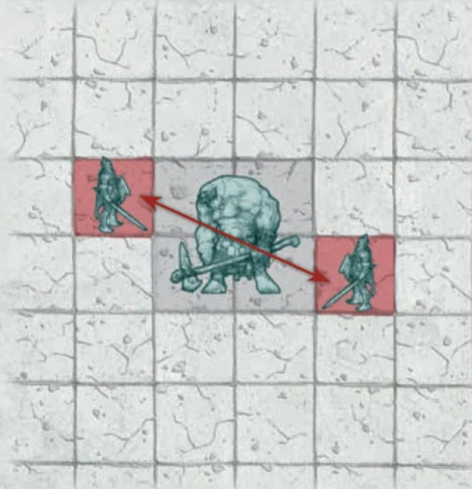
Flanking allows for advantage on attack rolls, if a combatant is flanked. That is, if two or more combatants surround a target in such a way that a line can be drawn through the enemy without leaving it’s square(s).
Limitations
- A create cannot flank an enemy it cannot see.
- A create cannot flank while it is incapacitated.
- Larger creatures are able to flank if any square they are standing on qualifies.
- The spell spiritual weapon and other non-creature objects cannot flank.
- Animal companions and familiars controlled by players can flank, if they have a combat ability.
- If a creature is two sizes larger than either of the flankers, the flanking does not count.
- If a conga line forms, the flank no longer counts.
- The Conga Line refers to a scenario where two PCs flank a monster. One of the Monster’s allies then comes to flank one of the PCs.1
- Aside from balance, this limitation is put in, as it doesn’t make much sense to both be flanked and flank at the same time.
- At least two flankers must face the enemy.